Everyone in AI has information. Almost no one has a map. The field reinvents its vocabulary every few months, and the result is not understanding, it is noise. The Atlas Of AI is my answer to that noise: one map of the field, where the point is not the words, it is how they connect.
A map, not an encyclopedia
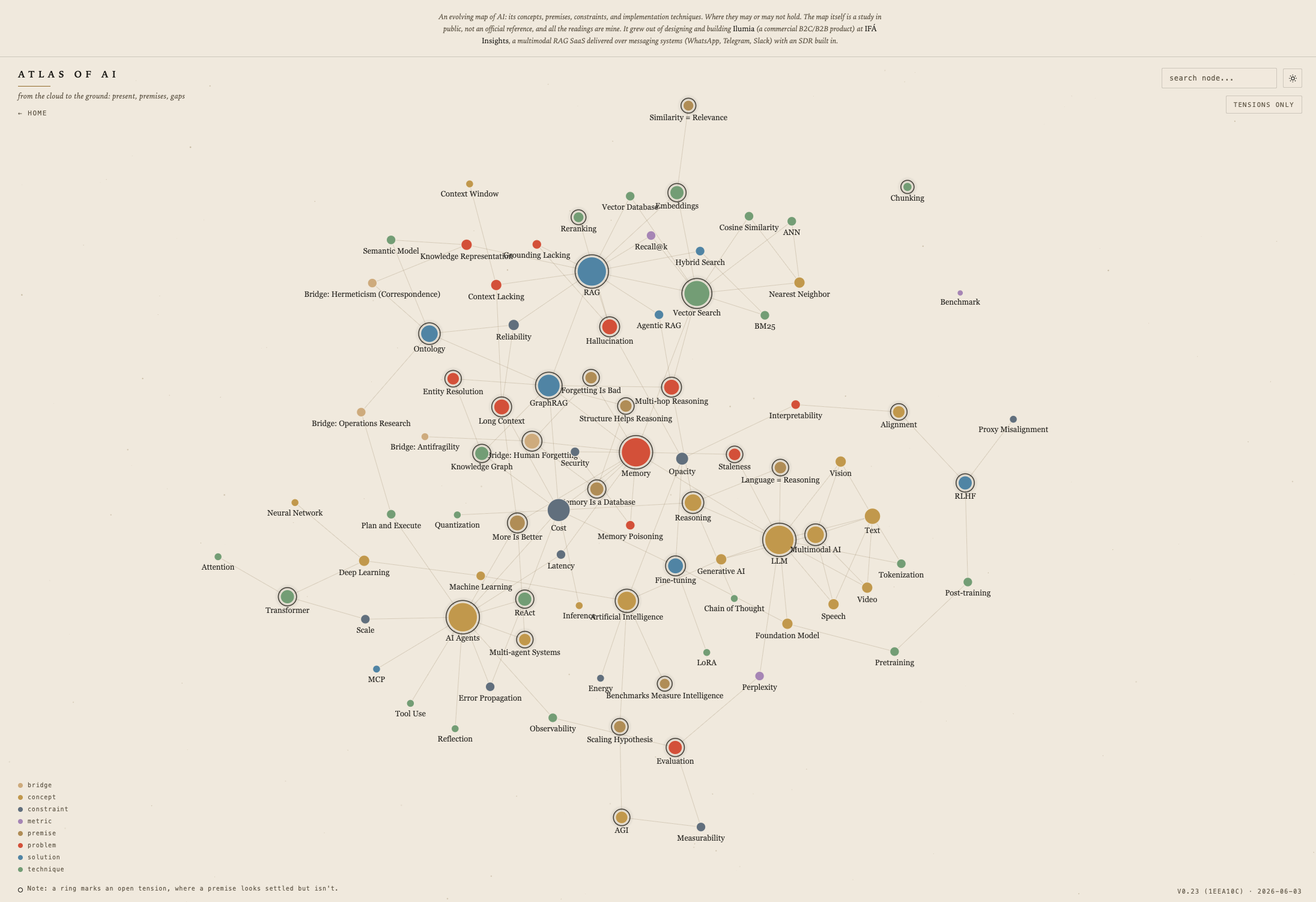
An encyclopedia tells you what each thing is. A map tells you how things relate, where they sit, and where the roads break. The Atlas is the second kind. Every idea in AI is a node, and what matters is the line between them.
The Atlas: every idea a node, every relationship a line.
The value of a field is rarely inside a single concept. It lives in the space between concepts, the place where one idea quietly depends on another, or contradicts it. That space is exactly where most people stop looking. The Atlas exists to make it visible.
A grammar for the field
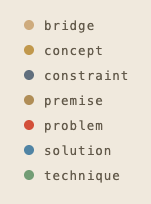
To map a field you need a grammar. Mine has one rule that does most of the work: type classifies, attributes describe. Every node is one of seven types: concept, problem, solution, technique, premise, bridge, constraint.
Eight types. Every idea declares what it is.
That sounds bureaucratic. It is the opposite. Forcing every idea to declare what it is exposes the confusion that prose hides. RAG feels like a thing until you ask whether it is an idea, a method, or a way of solving a problem. It is the latter. Knowledge representation feels like a tool until you ask the same question, again and again. Then, it shows itself: it is a problem. The grammar does not decorate the field. It disciplines it. Once every node knows what it is, the connections stop lying.
What is mine
Two things in the Atlas are not facts. They are my reading, and I mark them as such, because the honest move is to separate what the field agrees on from what I think.
Maturity is the market's view, not mine: emerging, contested, consolidating, established. It says how settled an idea is out there, and anyone can check it.
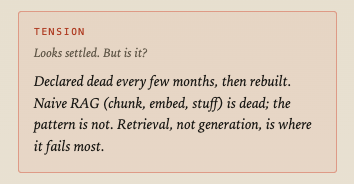
Tension: where something looks settled, but is it.
Tension is mine. Any node can carry one: the place where something looks settled but is not. It is the question I would put to a consensus that stopped questioning itself. RAG is established, and I still think the way we frame retrieval hides more than it solves. Both are true at once, and the Atlas holds both without flinching.
Then there are the bridges, the nodes that connect AI to things outside computing. Forgetting in neuroscience. Ontology as philosophy. The field treats these as decoration. I treat them as load-bearing, because the best ideas in technology usually arrived from somewhere else first.
How to read it
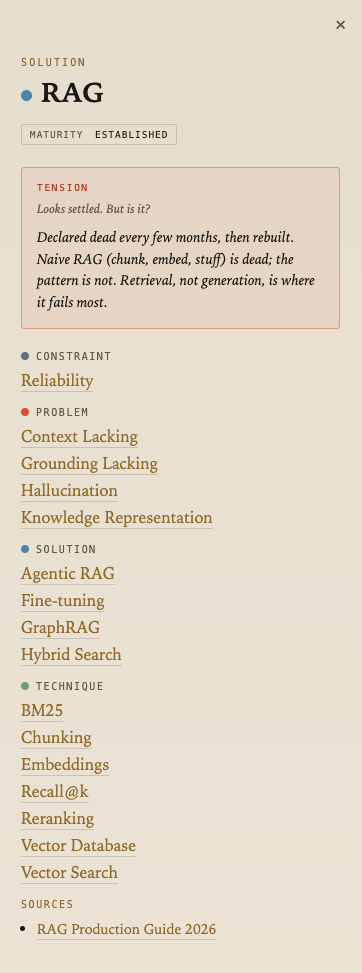
Take one corner of the map and pull the thread.
One node, all its connections, grouped by type.
Hallucination is a problem: the model states something false with full confidence. Next to it sit three more. Opacity, a constraint: you cannot see why the model answered, so you cannot catch the error from the inside. Grounding lacking, a problem: the answer is not tied to a source you can verify. Context lacking, also a problem: the model never had the information to begin with.
One solution cuts across all three. RAG fetches knowledge at the moment of the question and feeds it to the model, so the answer can be anchored in something outside the training data. And underneath it, one technique does most of the quiet heavy lifting: reranking, which reorders what retrieval found so the model sees the best evidence first.
That is the whole atlas method in miniature. You do not read a definition. You walk from a problem to its constraints, to the solutions that attack it, to the techniques that make those solutions work. The map teaches the relationships, which is precisely the part that definitions leave out.
Why I am doing this
Honestly, because it is how I think and learn, and because the field rewards the people who can hold the whole shape in their head while going deep in one corner. The Atlas is both at once: breadth in the graph, depth in each node.
It is a study in public, not an official reference. It will be wrong in places. It will change. The readings are mine, and I would rather be precisely wrong and fix it than vaguely right and forget why. The map is the argument.
Todo mundo em IA tem informação. Quase ninguém tem um mapa. O campo reinventa o próprio vocabulário a cada poucos meses, e o resultado não é entendimento, é ruído. O Atlas da IA é a minha resposta a esse ruído: um mapa do campo, onde o que importa não são as palavras, é como elas se conectam.
Um mapa, não uma enciclopédia
Uma enciclopédia te diz o que cada coisa é. Um mapa te diz como as coisas se relacionam, onde ficam, e onde as estradas se rompem. O Atlas é do segundo tipo. Cada ideia em IA é um nó, e o que importa é a linha entre eles.
O Atlas: cada ideia um nó, cada relação uma linha.
O valor de um campo raramente está dentro de um único conceito. Ele vive no espaço entre os conceitos, no lugar onde uma ideia depende silenciosamente de outra, ou a contradiz. Esse espaço é exatamente onde a maioria para de olhar. O Atlas existe para torná-lo visível.
Uma gramática para o campo
Para mapear um campo você precisa de uma gramática. A minha tem uma regra que faz a maior parte do trabalho: o tipo classifica, os atributos descrevem. Todo nó é de um entre oito tipos: conceito, problema, solução, técnica, métrica, premissa, ponte, restrição.
Oito tipos. Cada ideia declara o que é.
Parece burocrático. É o oposto. Forçar cada ideia a declarar o que é expõe a confusão que a prosa esconde. RAG parece uma coisa até você perguntar se é uma ideia, um método, ou um jeito de resolver um problema. É a última. Representação de conhecimento parece uma ferramenta até você fazer a mesma pergunta, de novo e de novo. Então ela se revela: é um problema. A gramática não decora o campo. Ela o disciplina. Quando todo nó sabe o que é, as conexões param de mentir.
O que é meu
Duas coisas no Atlas não são fatos. São a minha leitura, e eu as marco como tal, porque o movimento honesto é separar aquilo em que o campo concorda do que eu penso.
Maturidade é a visão do mercado, não a minha: emergente, contestado, consolidando, estabelecido. Diz o quão assentada uma ideia está lá fora, e qualquer um pode conferir.
Tensão: onde algo parece resolvido, mas será?
Tensão é minha. Qualquer nó pode carregar uma: o lugar onde algo parece resolvido mas não está. É a pergunta que eu faria a um consenso que parou de se questionar. RAG está estabelecido, e eu ainda acho que a forma como enquadramos a recuperação esconde mais do que resolve. As duas coisas são verdade ao mesmo tempo, e o Atlas sustenta as duas sem hesitar.
E há as pontes, os nós que conectam a IA a coisas fora da computação. Esquecimento na neurociência. Ontologia como filosofia. O campo trata isso como enfeite. Eu trato como estrutural, porque as melhores ideias em tecnologia quase sempre chegaram de outro lugar primeiro.
Como ler
Pegue um canto do mapa e puxe o fio.
Um nó, todas as suas conexões, agrupadas por tipo.
Alucinação é um problema: o modelo afirma algo falso com total confiança. Ao lado dela ficam outras três. Opacidade, uma restrição: você não consegue ver por que o modelo respondeu, então não pega o erro por dentro. Falta de ancoragem, um problema: a resposta não está presa a uma fonte que você possa verificar. Falta de contexto, também um problema: o modelo nunca teve a informação para começar.
Uma solução atravessa as três. RAG busca conhecimento no momento da pergunta e entrega ao modelo, para que a resposta possa ser ancorada em algo fora dos dados de treino. E por baixo dela, uma técnica faz a maior parte do trabalho silencioso: reranking, que reordena o que a busca encontrou para o modelo ver a melhor evidência primeiro.
Esse é o método do atlas inteiro em miniatura. Você não lê uma definição. Você caminha de um problema para suas restrições, para as soluções que o atacam, para as técnicas que fazem essas soluções funcionarem. O mapa ensina as relações, que é exatamente a parte que as definições deixam de fora.
Por que estou fazendo isto
Honestamente, porque é assim que eu penso e aprendo, e porque o campo recompensa quem consegue segurar a forma inteira na cabeça enquanto vai fundo em um canto. O Atlas é as duas coisas ao mesmo tempo: amplitude no grafo, profundidade em cada nó.
É um estudo em público, não uma referência oficial. Vai estar errado em alguns pontos. Vai mudar. As leituras são minhas, e eu prefiro estar precisamente errado e corrigir do que vagamente certo e esquecer por quê. O mapa é o argumento.
Todos en IA tienen información. Casi nadie tiene un mapa. El campo reinventa su vocabulario cada pocos meses, y el resultado no es comprensión, es ruido. El Atlas de la IA es mi respuesta a ese ruido: un mapa del campo, donde lo que importa no son las palabras, es cómo se conectan.
Un mapa, no una enciclopedia
Una enciclopedia te dice qué es cada cosa. Un mapa te dice cómo se relacionan las cosas, dónde están, y dónde se rompen los caminos. El Atlas es del segundo tipo. Cada idea en IA es un nodo, y lo que importa es la línea entre ellos.
El Atlas: cada idea un nodo, cada relación una línea.
El valor de un campo rara vez está dentro de un solo concepto. Vive en el espacio entre los conceptos, en el lugar donde una idea depende en silencio de otra, o la contradice. Ese espacio es exactamente donde la mayoría deja de mirar. El Atlas existe para hacerlo visible.
Una gramática para el campo
Para mapear un campo necesitas una gramática. La mía tiene una regla que hace la mayor parte del trabajo: el tipo clasifica, los atributos describen. Cada nodo es de uno entre ocho tipos: concepto, problema, solución, técnica, métrica, premisa, puente, restricción.
Ocho tipos. Cada idea declara lo que es.
Suena burocrático. Es lo contrario. Forzar a cada idea a declarar lo que es expone la confusión que la prosa esconde. RAG parece una cosa hasta que preguntas si es una idea, un método, o una forma de resolver un problema. Es lo último. Representación del conocimiento parece una herramienta hasta que haces la misma pregunta, una y otra vez. Entonces se revela: es un problema. La gramática no decora el campo. Lo disciplina. Cuando cada nodo sabe lo que es, las conexiones dejan de mentir.
Lo que es mío
Dos cosas en el Atlas no son hechos. Son mi lectura, y las marco como tal, porque el movimiento honesto es separar aquello en lo que el campo concuerda de lo que yo pienso.
Madurez es la visión del mercado, no la mía: emergente, en disputa, consolidando, establecido. Dice qué tan asentada está una idea allá afuera, y cualquiera puede verificarlo.
Tensión: donde algo parece resuelto, pero ¿lo está?
Tensión es mía. Cualquier nodo puede llevar una: el lugar donde algo parece resuelto pero no lo está. Es la pregunta que le haría a un consenso que dejó de cuestionarse. RAG está establecido, y aún creo que la forma en que enmarcamos la recuperación esconde más de lo que resuelve. Las dos cosas son verdad al mismo tiempo, y el Atlas sostiene ambas sin titubear.
Y están los puentes, los nodos que conectan la IA con cosas fuera de la computación. El olvido en la neurociencia. La ontología como filosofía. El campo los trata como adorno. Yo los trato como estructura, porque las mejores ideas en tecnología casi siempre llegaron primero desde otro lugar.
Cómo leerlo
Toma una esquina del mapa y tira del hilo.
Un nodo, todas sus conexiones, agrupadas por tipo.
Alucinación es un problema: el modelo afirma algo falso con total confianza. A su lado hay tres más. Opacidad, una restricción: no puedes ver por qué el modelo respondió, así que no atrapas el error desde dentro. Falta de anclaje, un problema: la respuesta no está atada a una fuente que puedas verificar. Falta de contexto, también un problema: el modelo nunca tuvo la información para empezar.
Una solución cruza las tres. RAG busca conocimiento en el momento de la pregunta y lo entrega al modelo, para que la respuesta pueda anclarse en algo fuera de los datos de entrenamiento. Y debajo de ella, una técnica hace la mayor parte del trabajo silencioso: reranking, que reordena lo que la búsqueda encontró para que el modelo vea la mejor evidencia primero.
Ese es el método del atlas entero en miniatura. No lees una definición. Caminas de un problema a sus restricciones, a las soluciones que lo atacan, a las técnicas que hacen funcionar esas soluciones. El mapa enseña las relaciones, que es justamente la parte que las definiciones dejan fuera.
Por qué hago esto
Honestamente, porque es como pienso y aprendo, y porque el campo recompensa a quien puede sostener la forma entera en la cabeza mientras profundiza en una esquina. El Atlas es las dos cosas a la vez: amplitud en el grafo, profundidad en cada nodo.
Es un estudio en público, no una referencia oficial. Estará equivocado en algunos puntos. Cambiará. Las lecturas son mías, y prefiero estar precisamente equivocado y corregirlo que vagamente en lo correcto y olvidar por qué. El mapa es el argumento.